Regional Licensing Variations Shape Feature Availability in Cross-Platform Wagering Applications
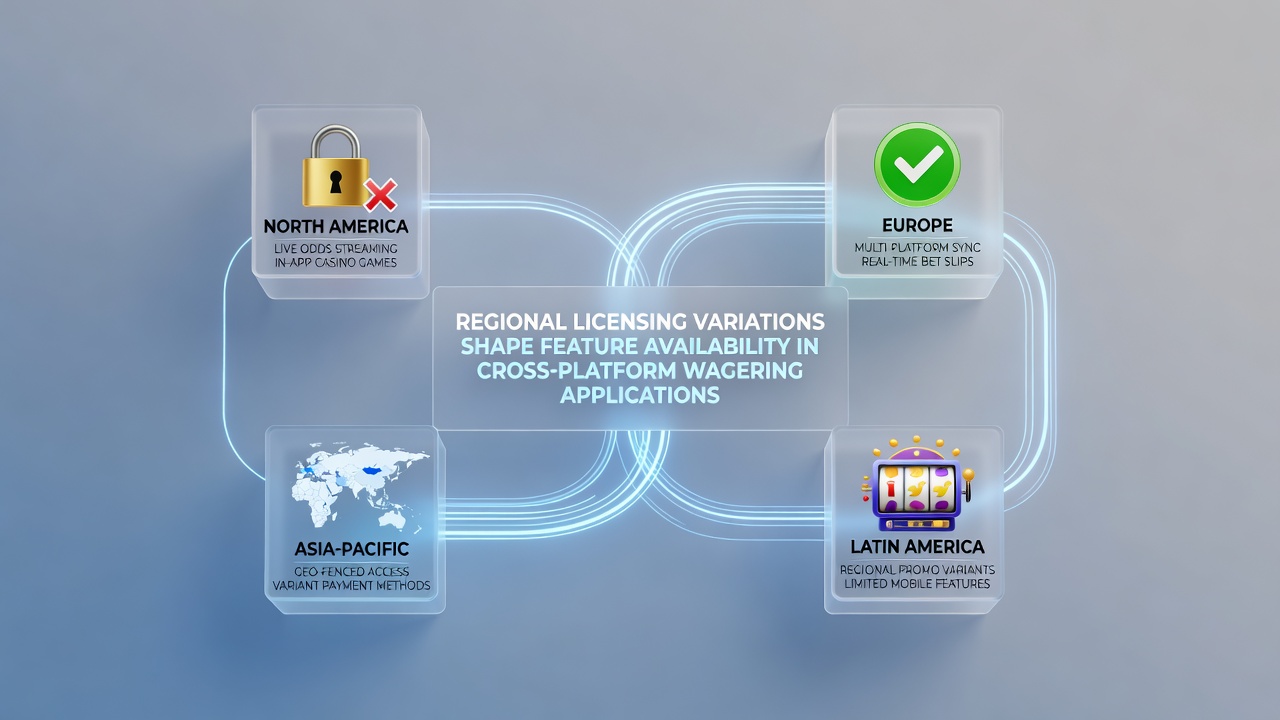 Licensing frameworks established by individual jurisdictions continue to dictate the precise set of tools and options developers can activate inside betting applications that operate across multiple devices and borders, creating a patchwork where users in one location see live streaming while those elsewhere encounter only basic score updates. Regulators in various states and countries impose distinct technical and operational requirements that force platforms to segment their codebases, disabling certain modules depending on the user's detected location and the license under which the app operates at that moment. Data from mid-2026 shows operators maintaining separate feature flags for each licensed territory, with June figures indicating over 40 percent of global wagering traffic routed through apps that dynamically adjust available bet types and payment rails in real time. This segmentation stems directly from license conditions that specify permissible game categories, maximum stake limits, and integration standards for third-party services such as identity verification providers or risk-management systems. **North American Market Contrasts**
State-level licensing in the United States produces some of the clearest examples of feature divergence. Pennsylvania's gaming control board requires geofencing that blocks cryptocurrency deposits even when the same app accepts them in neighboring jurisdictions, whereas New Jersey permits limited digital asset transactions under its own oversight rules. Observers note that these differences compel developers to maintain parallel compliance layers rather than a single unified feature set, increasing both development costs and update cycles. Canadian provinces add another layer, with Ontario's iGaming framework mandating specific responsible-gaming pop-ups that appear before certain parlay options become selectable, while other regions within the country allow those same combinations without the extra prompt. Applications therefore detect the user's provincial location and toggle the relevant interface elements accordingly, ensuring the displayed functionality matches the strictest applicable rule. **European and Asia-Pacific Patterns**
European licensing authorities impose comparable but distinct constraints. Malta's remote gaming authority permits in-app live dealer integrations under its license, yet operators serving German markets must disable those same streams because of federal restrictions on certain casino-style products. The result is an application that presents full live-betting interfaces to one user cohort while presenting only pre-match selections to another, all within the same downloadable package. Australian regulators have introduced their own variations since the beginning of 2026, requiring that bonus funds appear with extended wagering requirements displayed in real time, a rule not uniformly applied in neighboring markets. Research from the Australian Gambling Research Centre indicates that these display mandates affect engagement metrics differently across licensed operators, prompting developers to customize notification timing rather than apply a universal approach. **Technical Implementation Challenges**
Developers address these licensing mandates through modular architecture that loads or withholds entire feature branches based on license tokens validated at login. When a user crosses into a new regulatory zone, the app queries a compliance server that returns a configuration profile, activating or deactivating modules such as cash-out buttons, same-game parlay builders, or integrated streaming players. This server-driven approach avoids the need for separate app versions while still satisfying each license's technical specifications. Payment gateway availability follows the same logic. Some licenses prohibit certain e-wallet providers outright, forcing the app to hide those deposit options entirely once the user's location is confirmed. June 2026 transaction logs reveal that roughly one in five attempted deposits across major platforms were rerouted or blocked because the selected method failed the active license filter.
Licensing frameworks established by individual jurisdictions continue to dictate the precise set of tools and options developers can activate inside betting applications that operate across multiple devices and borders, creating a patchwork where users in one location see live streaming while those elsewhere encounter only basic score updates. Regulators in various states and countries impose distinct technical and operational requirements that force platforms to segment their codebases, disabling certain modules depending on the user's detected location and the license under which the app operates at that moment. Data from mid-2026 shows operators maintaining separate feature flags for each licensed territory, with June figures indicating over 40 percent of global wagering traffic routed through apps that dynamically adjust available bet types and payment rails in real time. This segmentation stems directly from license conditions that specify permissible game categories, maximum stake limits, and integration standards for third-party services such as identity verification providers or risk-management systems. **North American Market Contrasts**
State-level licensing in the United States produces some of the clearest examples of feature divergence. Pennsylvania's gaming control board requires geofencing that blocks cryptocurrency deposits even when the same app accepts them in neighboring jurisdictions, whereas New Jersey permits limited digital asset transactions under its own oversight rules. Observers note that these differences compel developers to maintain parallel compliance layers rather than a single unified feature set, increasing both development costs and update cycles. Canadian provinces add another layer, with Ontario's iGaming framework mandating specific responsible-gaming pop-ups that appear before certain parlay options become selectable, while other regions within the country allow those same combinations without the extra prompt. Applications therefore detect the user's provincial location and toggle the relevant interface elements accordingly, ensuring the displayed functionality matches the strictest applicable rule. **European and Asia-Pacific Patterns**
European licensing authorities impose comparable but distinct constraints. Malta's remote gaming authority permits in-app live dealer integrations under its license, yet operators serving German markets must disable those same streams because of federal restrictions on certain casino-style products. The result is an application that presents full live-betting interfaces to one user cohort while presenting only pre-match selections to another, all within the same downloadable package. Australian regulators have introduced their own variations since the beginning of 2026, requiring that bonus funds appear with extended wagering requirements displayed in real time, a rule not uniformly applied in neighboring markets. Research from the Australian Gambling Research Centre indicates that these display mandates affect engagement metrics differently across licensed operators, prompting developers to customize notification timing rather than apply a universal approach. **Technical Implementation Challenges**
Developers address these licensing mandates through modular architecture that loads or withholds entire feature branches based on license tokens validated at login. When a user crosses into a new regulatory zone, the app queries a compliance server that returns a configuration profile, activating or deactivating modules such as cash-out buttons, same-game parlay builders, or integrated streaming players. This server-driven approach avoids the need for separate app versions while still satisfying each license's technical specifications. Payment gateway availability follows the same logic. Some licenses prohibit certain e-wallet providers outright, forcing the app to hide those deposit options entirely once the user's location is confirmed. June 2026 transaction logs reveal that roughly one in five attempted deposits across major platforms were rerouted or blocked because the selected method failed the active license filter. 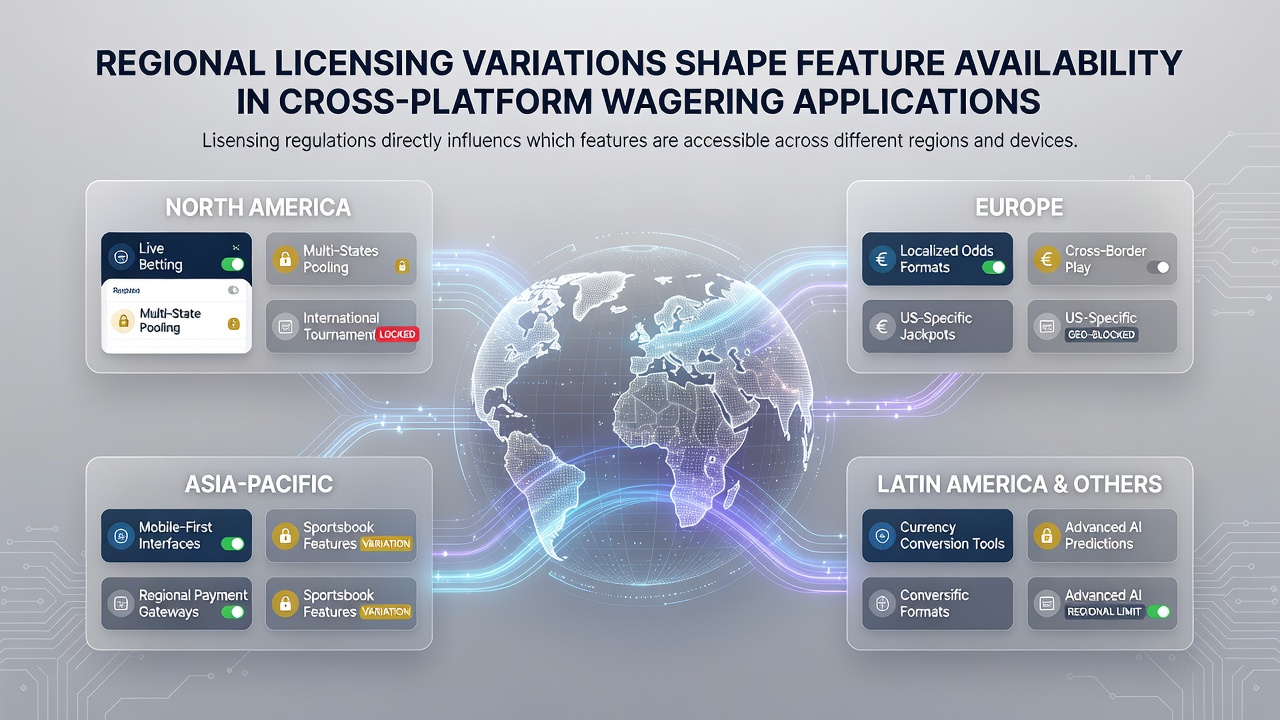 **User Experience and Market Reach**
Players who travel or maintain accounts across borders frequently encounter sudden changes in available tools, such as the disappearance of boosted odds or the addition of mandatory cooling-off timers. These shifts occur automatically as the application detects new network signals or IP addresses tied to different licensed territories. The approach maintains regulatory compliance without requiring users to download region-specific versions. Industry reports compiled in early 2026 highlight that cross-platform applications now allocate significant engineering resources to license-aware feature management, with some operators employing dedicated compliance teams that review each new jurisdiction's rules before any feature rollout. This process ensures that innovations like enhanced parlay builders reach only those markets whose licenses explicitly permit the underlying mechanics. **Conclusion**
Regional licensing regimes therefore function as the primary gatekeepers for which capabilities reach end users inside cross-platform wagering applications, producing a fragmented yet legally compliant global landscape. Operators continue refining detection and configuration systems to balance regulatory adherence with consistent user experiences wherever possible, while data collected through June 2026 underscores that these variations remain a core structural element of the industry rather than a temporary obstacle.
**User Experience and Market Reach**
Players who travel or maintain accounts across borders frequently encounter sudden changes in available tools, such as the disappearance of boosted odds or the addition of mandatory cooling-off timers. These shifts occur automatically as the application detects new network signals or IP addresses tied to different licensed territories. The approach maintains regulatory compliance without requiring users to download region-specific versions. Industry reports compiled in early 2026 highlight that cross-platform applications now allocate significant engineering resources to license-aware feature management, with some operators employing dedicated compliance teams that review each new jurisdiction's rules before any feature rollout. This process ensures that innovations like enhanced parlay builders reach only those markets whose licenses explicitly permit the underlying mechanics. **Conclusion**
Regional licensing regimes therefore function as the primary gatekeepers for which capabilities reach end users inside cross-platform wagering applications, producing a fragmented yet legally compliant global landscape. Operators continue refining detection and configuration systems to balance regulatory adherence with consistent user experiences wherever possible, while data collected through June 2026 underscores that these variations remain a core structural element of the industry rather than a temporary obstacle.
Licensing frameworks established by individual jurisdictions continue to dictate the precise set of tools and options developers can activate inside betting applications that operate across multiple devices and borders, creating a patchwork where users in one location see live streaming while those elsewhere encounter only basic score updates. Regulators in various states and countries impose distinct technical and operational requirements that force platforms to segment their codebases, disabling certain modules depending on the user's detected location and the license under which the app operates at that moment. Data from mid-2026 shows operators maintaining separate feature flags for each licensed territory, with June figures indicating over 40 percent of global wagering traffic routed through apps that dynamically adjust available bet types and payment rails in real time. This segmentation stems directly from license conditions that specify permissible game categories, maximum stake limits, and integration standards for third-party services such as identity verification providers or risk-management systems. **North American Market Contrasts**
State-level licensing in the United States produces some of the clearest examples of feature divergence. Pennsylvania's gaming control board requires geofencing that blocks cryptocurrency deposits even when the same app accepts them in neighboring jurisdictions, whereas New Jersey permits limited digital asset transactions under its own oversight rules. Observers note that these differences compel developers to maintain parallel compliance layers rather than a single unified feature set, increasing both development costs and update cycles. Canadian provinces add another layer, with Ontario's iGaming framework mandating specific responsible-gaming pop-ups that appear before certain parlay options become selectable, while other regions within the country allow those same combinations without the extra prompt. Applications therefore detect the user's provincial location and toggle the relevant interface elements accordingly, ensuring the displayed functionality matches the strictest applicable rule. **European and Asia-Pacific Patterns**
European licensing authorities impose comparable but distinct constraints. Malta's remote gaming authority permits in-app live dealer integrations under its license, yet operators serving German markets must disable those same streams because of federal restrictions on certain casino-style products. The result is an application that presents full live-betting interfaces to one user cohort while presenting only pre-match selections to another, all within the same downloadable package. Australian regulators have introduced their own variations since the beginning of 2026, requiring that bonus funds appear with extended wagering requirements displayed in real time, a rule not uniformly applied in neighboring markets. Research from the Australian Gambling Research Centre indicates that these display mandates affect engagement metrics differently across licensed operators, prompting developers to customize notification timing rather than apply a universal approach. **Technical Implementation Challenges**
Developers address these licensing mandates through modular architecture that loads or withholds entire feature branches based on license tokens validated at login. When a user crosses into a new regulatory zone, the app queries a compliance server that returns a configuration profile, activating or deactivating modules such as cash-out buttons, same-game parlay builders, or integrated streaming players. This server-driven approach avoids the need for separate app versions while still satisfying each license's technical specifications. Payment gateway availability follows the same logic. Some licenses prohibit certain e-wallet providers outright, forcing the app to hide those deposit options entirely once the user's location is confirmed. June 2026 transaction logs reveal that roughly one in five attempted deposits across major platforms were rerouted or blocked because the selected method failed the active license filter.
**User Experience and Market Reach**
Players who travel or maintain accounts across borders frequently encounter sudden changes in available tools, such as the disappearance of boosted odds or the addition of mandatory cooling-off timers. These shifts occur automatically as the application detects new network signals or IP addresses tied to different licensed territories. The approach maintains regulatory compliance without requiring users to download region-specific versions. Industry reports compiled in early 2026 highlight that cross-platform applications now allocate significant engineering resources to license-aware feature management, with some operators employing dedicated compliance teams that review each new jurisdiction's rules before any feature rollout. This process ensures that innovations like enhanced parlay builders reach only those markets whose licenses explicitly permit the underlying mechanics. **Conclusion**
Regional licensing regimes therefore function as the primary gatekeepers for which capabilities reach end users inside cross-platform wagering applications, producing a fragmented yet legally compliant global landscape. Operators continue refining detection and configuration systems to balance regulatory adherence with consistent user experiences wherever possible, while data collected through June 2026 underscores that these variations remain a core structural element of the industry rather than a temporary obstacle.